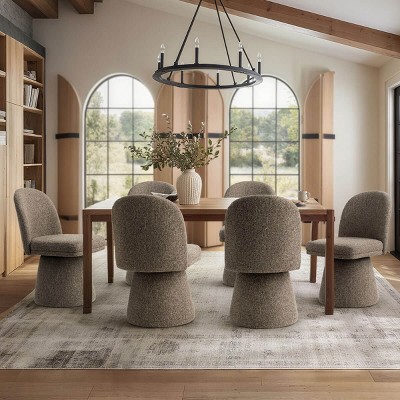
8 Dining Room Finds: Organic Modern
Organic modern dining rooms balance raw materiality with quiet sophistication — concrete surfaces, textural wool underfoot, sculptural lighting that doubles as art. The palette is neutral but never flat; the forms are clean but never cold. These 8 carefully chosen picks give you the full look, from foundation pieces to finishing details.
The Organic Modern Dining Formula
Three layers make this style work: a grounded table in an earthy material, seating with warmth and function, and lighting that creates atmosphere. Add a rug to define the zone, a candelabra for candlelit dinners, a vase and decorative bowl as quiet centrepieces, and a storage piece that doubles as a display surface. That's the whole room.
The 8 Finds
1. Moe's Home Collection Warby Dining Table — Concrete Beige
- Retailer: Amazon
- Shop: Moe's Warby Dining Table — Amazon → (affiliate link)
2. Set of 6 Modern 360° Swivel Armless Dining Chairs — Brown
- Retailer: Target
- Shop: Set of 6 Swivel Armless Dining Chairs — Target → (affiliate link)
3. HVVRNEWF Wabi-Sabi Acrylic Chandelier — Grain-Textured
- Retailer: Amazon
- Shop: Wabi-Sabi Grain Acrylic Chandelier — Amazon → (affiliate link)
4. Nazco Abstract New Zealand Wool Rug — Cream
- Retailer: Rugs USA
- Shop: Nazco Abstract New Zealand Wool Rug, Cream — Rugs USA → (affiliate link)
5. Kahn 41" Ribbed Whitewashed Ash Wood Storage Cabinet — Crate & Barrel
- Retailer: Crate & Barrel
- Shop: Kahn 41" Ribbed Whitewashed Ash Cabinet — Crate & Barrel → (affiliate link)
6. Cinq Black Multi Candelabra — CB2
- Retailer: CB2
- Shop: Cinq Black Multi Candelabra — CB2 → (affiliate link)
7. Kokrose Black Terracotta Vase — 11.2"
- Retailer: Amazon
- Shop: Kokrose Black Terracotta Vase, 11.2" — Amazon → (affiliate link)
8. Modern Metal Pedestal Decorative Bowl — 9", Black
- Retailer: Target
- Shop: Modern Metal Pedestal Decorative Bowl, 9", Black — Target → (affiliate link)
How to Layer It
Start with the table and chairs — they set the scale and tone for everything else. Add the rug next to define the dining zone. Hang the chandelier before you place anything on the table: the light level determines how the whole room reads. Then bring in the sideboard, candelabra, vase, and bowl as the final layer. The vase and pedestal bowl work as a pair on the table; the candelabra goes between them. You'll know immediately what the room is.
Make It Work for Your Specific Space
The dining room layout matters as much as the furniture selections. At Home Plans offers dining room floor plans that show you exactly how to arrange seating, lighting, and storage for rooms of every size — from compact open-plan dining zones to formal dedicated dining rooms.
Dining Room Ideas: Layout, Color Palette, and Lighting
Great dining room design comes down to three decisions made in the right order: how to arrange the room, what palette to build around, and how to light it for the full range of daily and evening use.
Dining Room Layout Guidance
Scale the table to the room first. A dining table needs 36 inches of clearance on all sides — from table edge to wall or other furniture — so chairs can pull out fully and guests can circulate freely. In a 12 × 14-foot room, a 72-inch rectangular table (seats 6) fits well; a 96-inch table in the same space is too large.
Table shape affects how a room feels:
- Rectangular: Suits rooms with a clear length dimension; creates a defined head-of-table axis
- Round: Works best in square rooms; improves conversation since everyone faces the center
- Oval: The versatile middle ground — conversational like a round but with the seating capacity of a rectangle
Each diner needs 24 inches of table width to eat comfortably. Don't crowd chairs below this benchmark, even at casual dining tables.
Hang the chandelier over the table, not the room's center. If your table is positioned toward one end of the room (common in open-plan living-dining spaces), the chandelier follows the table. The bottom of the fixture should hang 30 to 36 inches above the table surface for standard 8-foot ceilings.
Dining Room Decor Ideas: Color Palette Suggestions
Warm neutrals — creamy whites, warm taupes, sandy beiges — are the most versatile starting point. They read airy in daylight and intimate by candlelight, adapting across seasons and occasions. Pair with aged brass hardware, warm wood chairs, and linen textiles for depth without darkness.
Terracotta and clay bring warmth without committing to a saturated color. A terracotta accent wall behind the sideboard adds earthiness that complements concrete, natural wood, and organic modern materials without overwhelming the space.
Deep, moody tones — forest green, inky navy, charcoal — create a cocooning effect that suits a dining room designed for evening use. Against a dark ground, candlelight and warm wood read with high contrast and real drama. Best in a dedicated dining room rather than an open-plan space.
All-white with texture succeeds when texture carries the visual weight: a chunky wool rug, a concrete or live-edge table, linen upholstered chairs. Without texture, all-white dining rooms look clinical; with it, they feel clean and quietly luxurious.
Dining Room Lighting Tips
The chandelier is the single most important design decision in a dining room — and the one most often underestimated.
Size the chandelier correctly. Add the room's length and width in feet; that number converted to inches gives the ideal chandelier diameter. A 12 × 14-foot room calls for a chandelier approximately 26 inches wide. Most dining rooms suffer from undersized fixtures that get lost overhead — err larger.
Always install a dimmer. Full brightness for weekday lunches and homework; 30–40% for dinner; near-dark when candles take over after the meal. A chandelier without a dimmer is a missed opportunity.
Layer your light sources:
- Chandelier or pendant — ambient illumination centered over the table
- Sconces or picture lights — accent lighting over a sideboard, bar cabinet, or artwork
- Candles — the most transformative layer: a single candelabra shifts the mood from functional to atmospheric
Height matters. For 8-foot ceilings, hang the bottom of the chandelier 30 to 36 inches above the table surface. Add 3 inches for each additional foot of ceiling height.
Tags: Organic Modern Dining Room, Dining Room Decor, Dining Room Ideas, Natural Dining Room, Concrete Dining Table, Swivel Dining Chairs, Wabi-Sabi Interior, Organic Modern Interior
Not sure which pieces to prioritise? How to Choose Furniture for a Room covers scale, proportion, and budget balance for every dining space.